.svg)

Questions? Call us:
+971 4 447 1776

.svg)
Salimus Integrity is now a full web platform at integrity.envelopetesting.com. It takes a clean agent enclosure from door fan readings to a finalized, numbered PDF report. The same workspace also holds your clients, sites and calibrated equipment. It works in any browser and there is nothing to install. It is free for companies that test with TEC (The Energy Conservatory) door fans.
If you test with a TEC Minneapolis door fan, this is what your workflow now looks like. We follow one real test on a demo server room, step by step: 240 m³, HFC-227ea, 10-minute hold time required. Every number below comes from the live app.
Each testing company gets its own private workspace. Your company admin invites technicians, and every user sees only your company's data.
Work is organised the way a contractor thinks about it: Client → Project → Site → Enclosure. Room volume and heights are stored with the enclosure, so a retest starts from the same geometry.
The Equipment register holds each door fan's serial number, calibration certificate and validity dates. When you save a test you pick the fan from this list, and the report prints the instrument and its calibration automatically.
Choose the standard (NFPA 2001 or ISO 14520-1) and the mixing assumption. Then enter the enclosure: volume, maximum height H₀, protected height H, lower leak fraction F and the required hold time. Our demo room is 240 m³, H₀ = 3.0 m, H = 2.5 m, F = 0.5, 10 minutes.
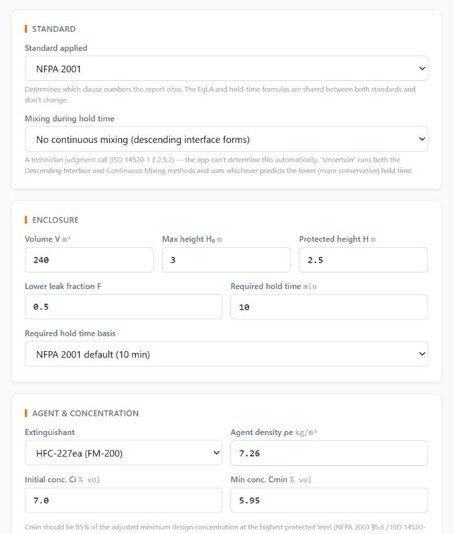
Pick the agent and the app fills its density. Enter the design and minimum concentrations: here HFC-227ea at 7.0% initial and 5.95% minimum. Before you even set up the fan, the pre-test estimate gives the largest leakage area the room can have and still pass: 444 cm² in this case. It tells you on site whether sealing is needed before you start.
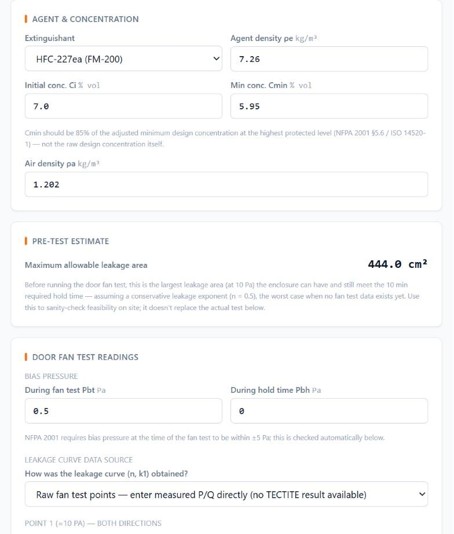
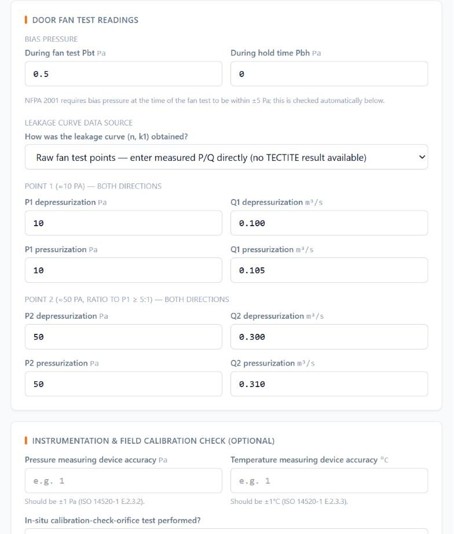
Enter the bias pressure, then the leakage curve. You can type the n and k₁ values from TECTITE, or enter the raw pressure and flow points in both directions and let the engine fit the curve. Our demo used raw points at 10 Pa and 50 Pa, depressurization and pressurization.
Press Calculate and the predicted hold time appears at once, with pass or fail against the required time. The standards give two models for how agent leaves a room:
· Descending Interface: the agent–air interface drops as agent leaks out low and air enters high. This is the default when there is no continuous mixing.
· Continuous Mixing: fans or air handling keep the room mixed, so the whole room slowly dilutes.
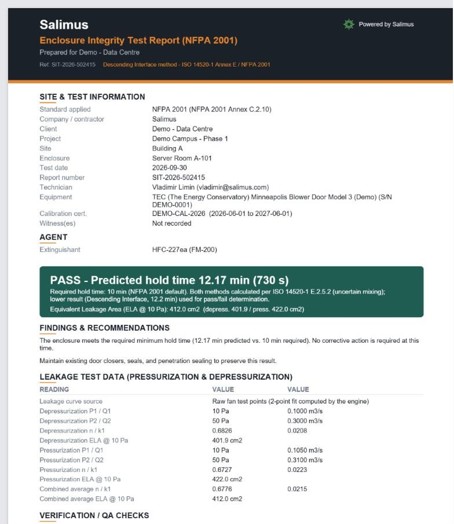
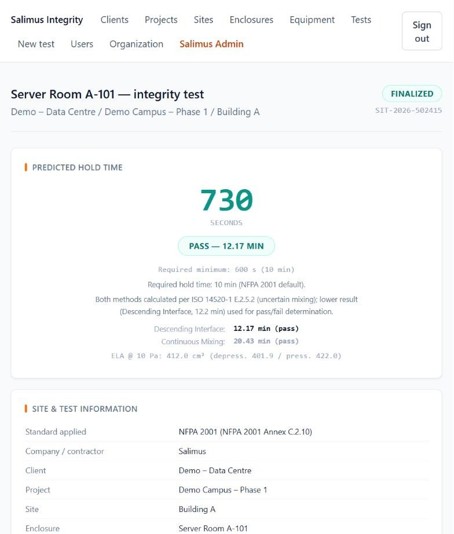
If you can't say which applies, choose "Uncertain". The app runs both methods and uses the lower result for pass/fail, as ISO 14520-1 E.2.5.2 requires. In the demo, Descending Interface gives 12.17 minutes and Continuous Mixing 20.43 minutes, so 12.17 minutes governs: a pass against 10 minutes.
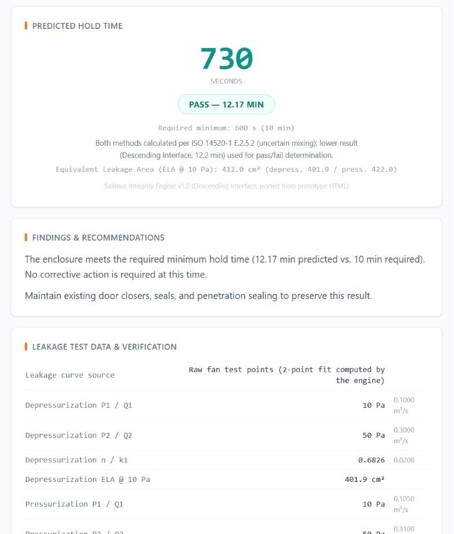
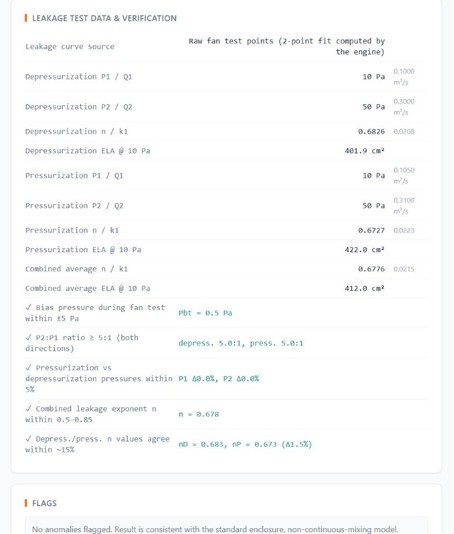
Below the result, the leakage data table shows n, k₁ and the Equivalent Leakage Area (ELA) for each direction: 412 cm² combined here. The QA checks are automatic: bias pressure limit, the 5:1 pressure ratio, the flow exponent range, and agreement between pressurization and depressurization. Anything out of range is flagged before the report is issued.
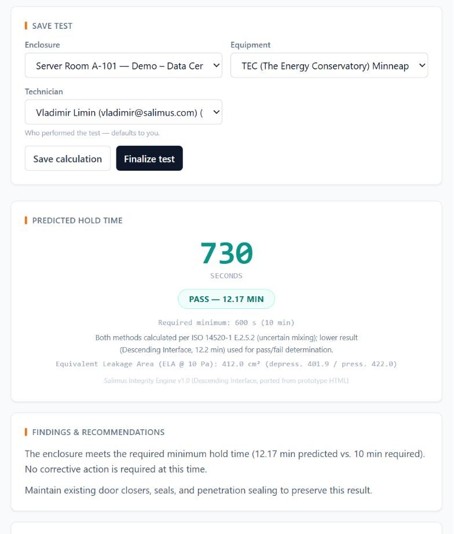
Select the enclosure, the door fan and the technician, then Finalize test. The server recalculates the result from the saved inputs, so the finalized number is the engine's number, not a value typed into a form. The test gets a unique report number (here SIT-2026-502415).
The finalized record keeps the full chain: client, project,site, enclosure, equipment and both hold-time results.
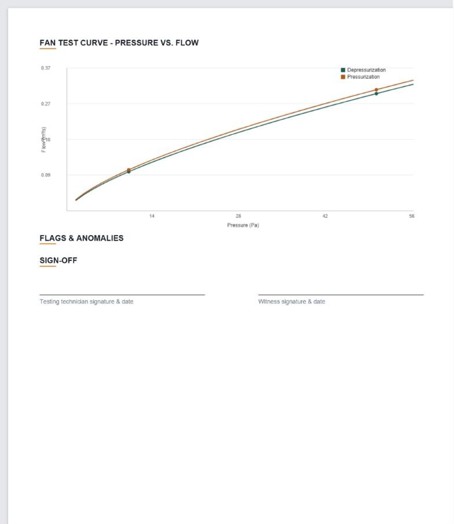
One click produces the PDF report. Page 1 carries the site and test information, instrument and calibration, the pass/fail result with the governing method, findings, and the leakage data. Page 2 plots the fan test curve and leaves space for the technician's and witness's signatures.
Two engineering modules start from a finalized test and reuse its leakage data.
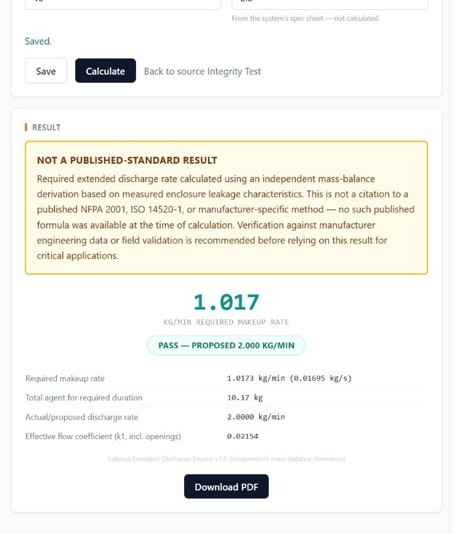
Extended Discharge answers: if the room can't hold the concentration long enough, how much agent must be added per minute to keep it above the minimum? For the demo room, holding 5.95% for 10 minutes needs 1.02kg/min (10.2 kg in total). A proposed 2.0 kg/min system passes. The result is clearly labelled as an engineering mass-balance calculation, not a published-standard method, so it should be checked against the manufacturer's data.
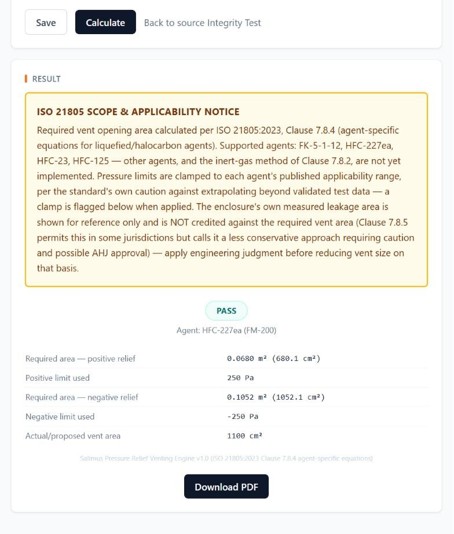
Pressure Relief Venting sizes the vent area for the discharge pressure peak, using ISO 21805:2023 Clause 7.8.4. The demo discharge is 131 kg of HFC-227ea in 10 s at 50% RH, with a ±250 Pa room limit. It needs680 cm² for positive relief and 1052 cm² for negative relief. The proposed 1100cm² vent passes both.
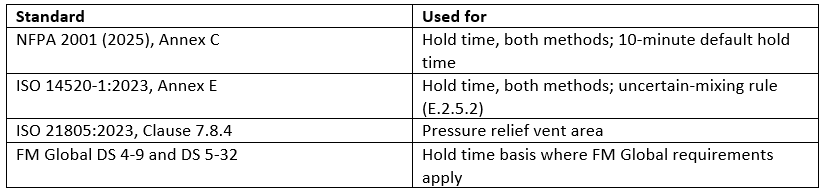
Every calculation is checked against a worked example in our automated test suite on each release. Every result shows the engine version that produced it.
Salimus Integrity is included free with every new TEC door fan purchased from Salimus, the official TEC distributor for the MENA region. Other companies can register at integrity.envelopetesting.com and start with a 30-day trial.
For a demo or pricing, contact Salimus: Info@salimus.com, +971 4 447 1776. Offices in Dubai (Office 111, Concorde Tower, JLT), Riyadh and Amman.


.svg)
.svg)