.svg)

Questions? Call us:
+971 4 447 1776

.svg)
A clean-agent fire suppression system must do more than discharge the correct quantity of extinguishing agent. The protected enclosure must retain the agent at or above the required minimum concentration for the specified hold time. Leakage through doors, cable penetrations, raised floors, ceilings, ducts, service openings and other pathways can allow the concentration to decay too quickly.
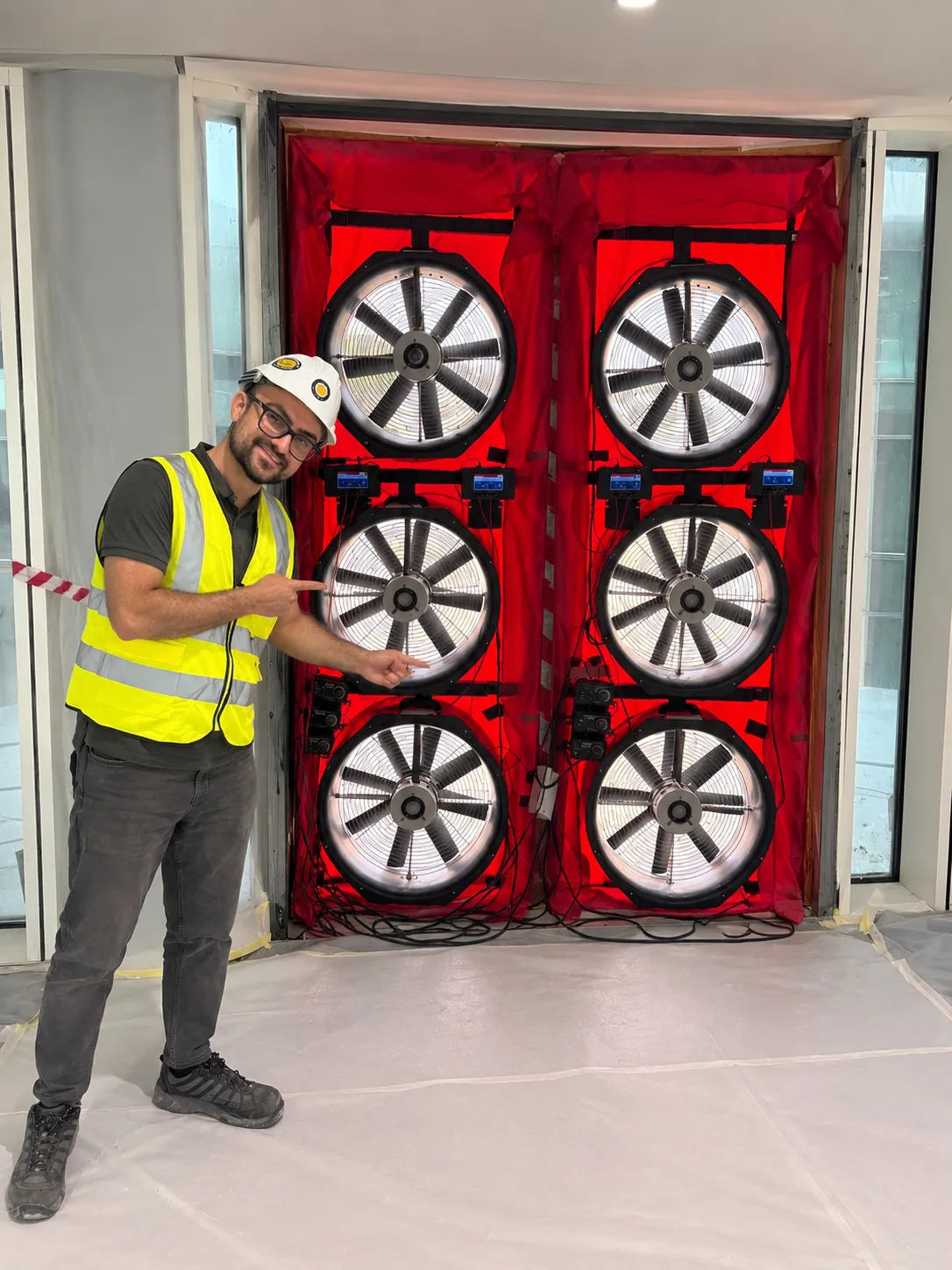
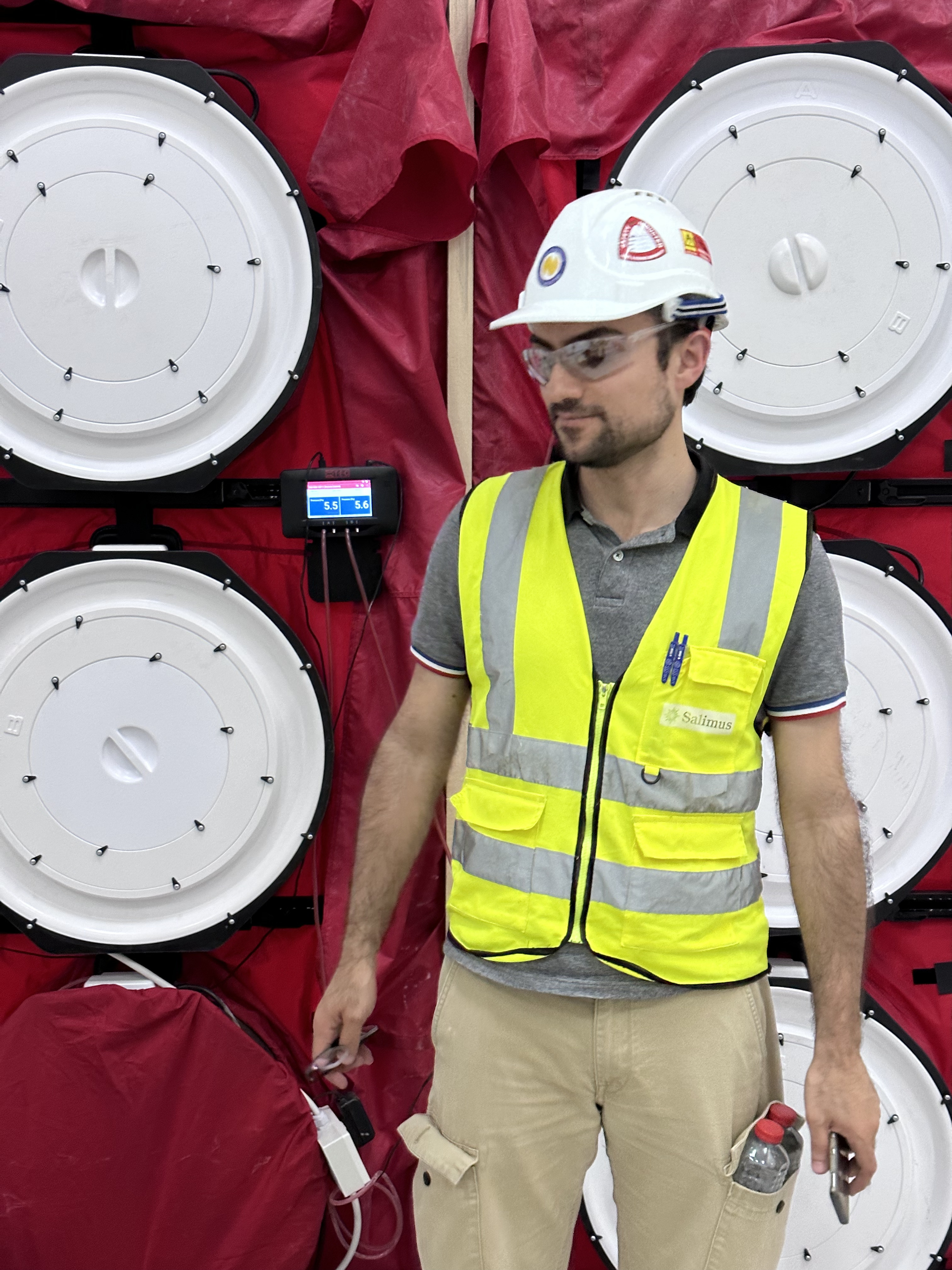
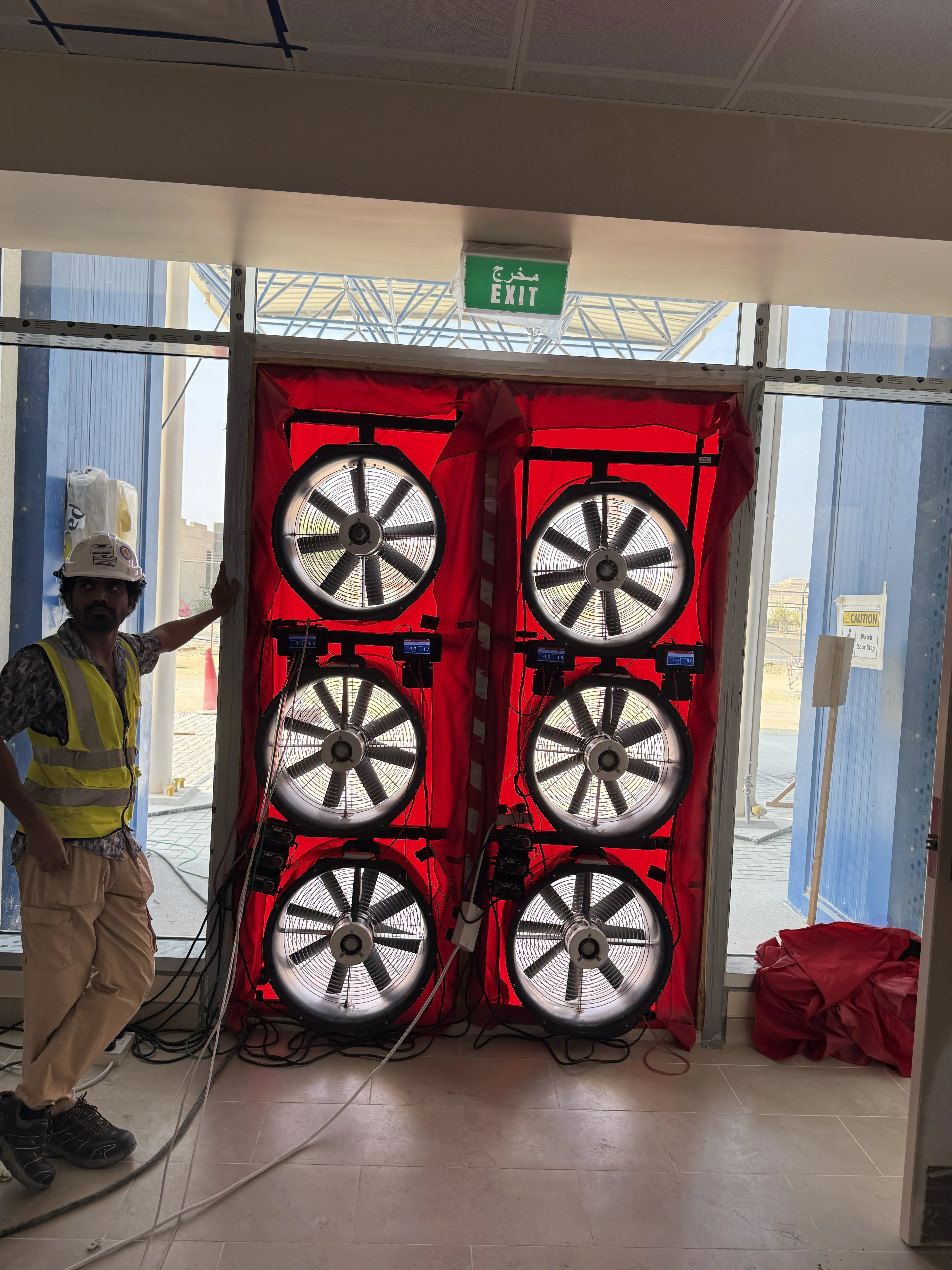
Room Integrity Testing - also called Enclosure Integrity Testing or a Door Fan Test - provides a non-destructive way to evaluate this performance without discharging the clean agent. A calibrated door-fan system is used to pressurize and depressurize the enclosure, establishing its leakage characteristics.
Salimus has developed a web-based Integrity Test Calculator specifically to extend the normal TEC door-fan workflow into clean-agent enclosure hold-time analysis and reporting. The tool follows the door-fan method described in NFPA 2001 Annex C and the equivalent ISO 14520-1 Annex E procedure.
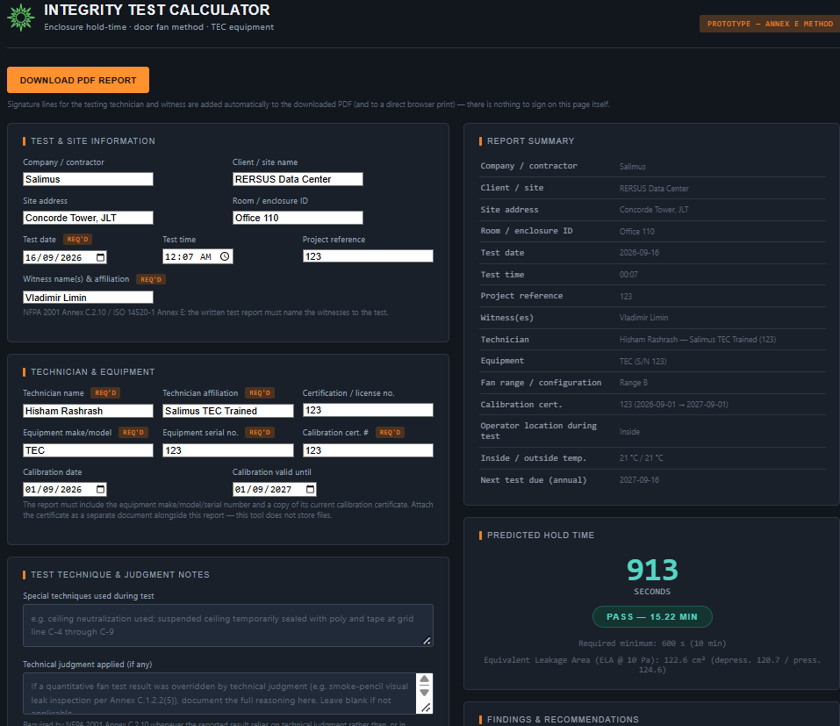
The technician enters the Site, Technician, Enclosure, Agent and Door-fan test information.The software then computes the leakage curve, Equivalent Leakage Area (EqLA), predicted agent hold time and PASS/FAIL result, while also performing quality checks and generating a professional PDF report.
The software supports the two field workflows most likely to be encountered:
Optional cross-checks can include the correlation coefficient from a genuine multi-point test and the TECTITE Canadian EqLA at 10 Pa. The application can flag discrepancies that may indicate a units or data-entry problem.
After the door-fan and enclosure information is entered, the result is presented immediately. In the demonstration shown in Figure 1, the application predicts a hold time of 913 seconds (15.22 minutes) against a required minimum of 600 seconds (10 minutes), resulting in a clear PASS.
The same results area displays the Equivalent Leakage Area at 10 Pa, including depressurization, pressurization and combined values. This gives the technician a fast result while retaining the engineering data behind the decision.
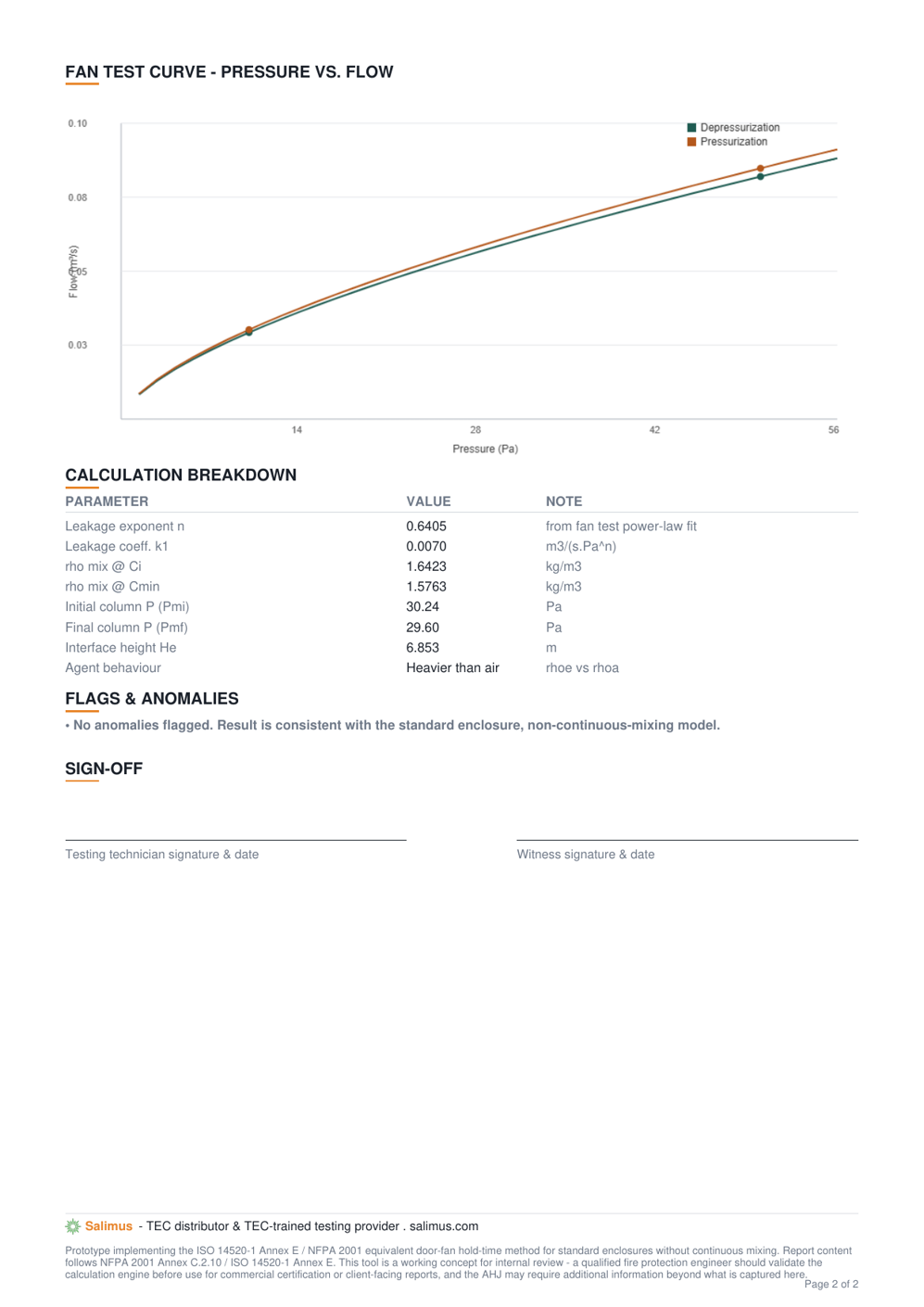
The Salimus application is designed to preserve engineering traceability rather than operate as a black-box calculator. It provides the leakage exponent, leakage coefficient, EqLA, mixture-density and column-pressure parameters, interface height and other calculation information used to review the predicted hold time.
The software also records project and test details, technician and equipment information, calibration certificate references, enclosure geometry, extinguishing-agent data, test techniques, engineering judgment, identified leakage locations and remediation notes.
Field testing can be affected by background pressure, damper movement, directional leakage behaviour, insufficient pressure separation, unusual leakage exponents or simple data-entry errors. The Salimus application therefore performs automated checks and flags conditions that deserve review.
These checks support the technician and reviewing engineer; they do not replace professional judgment.
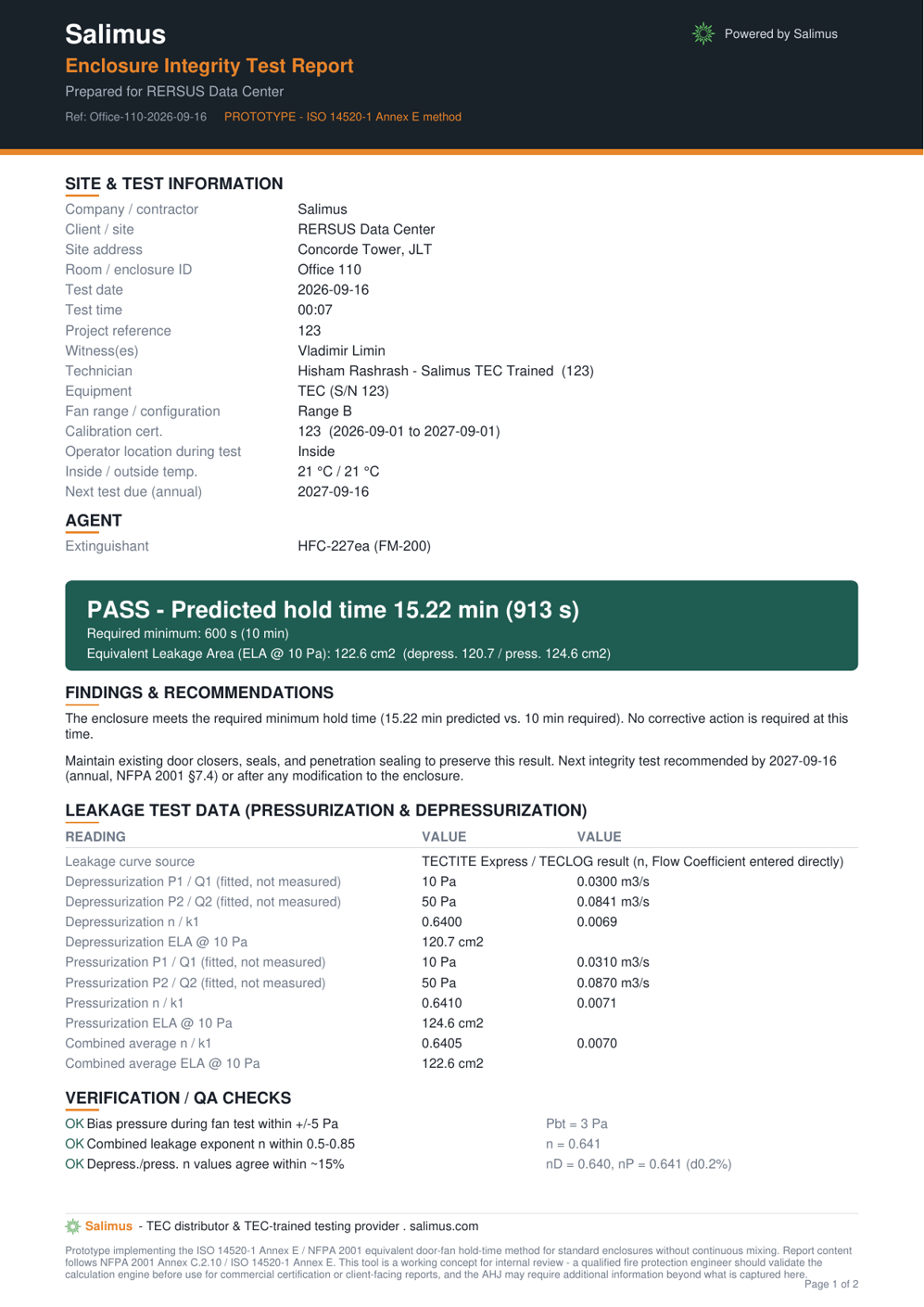
Once the test has been reviewed, the technician can select Download PDF Report. The application automatically converts the project and test data into a structured Enclosure Integrity Test Report.
The generated report includes site and witness information, technician and calibrated equipment details, the PASS/FAIL result, predicted hold time, EqLA, findings and recommendations, leakage test data, verification checks, the fan pressure-versus-flow curve, calculation breakdown, flags/anomalies and sign-off lines for the testing technician and witness.
The workflow is particularly useful for data centres and other mission-critical facilities, where a project may contain many individually protected server, electrical, UPS, telecom and control rooms. A repeatable process for collecting data, checking test quality, calculating retention performance and producing consistent documentation can significantly simplify testing across multiple enclosures.
TEC EQUIPMENT + SALIMUS SOFTWARE + SALIMUS TECHNICAL SUPPORT
Every compatible TEC fan system purchased from Salimus now includes access to the Salimus Integrity Test Calculator and PDF reporting application at no additional software charge.
This means the testing company receives not only the calibrated fan equipment needed to measure enclosure leakage, but also a purpose-built Salimus interface for converting those measurements into clean-agent hold-time calculations and professional reports - without a separate integrity-calculation software purchase.
Salimus can support clients with TEC equipment supply, the Salimus Integrity Test Calculator, technician training, interpretation of results, and direct room-integrity and building-airtightness testing services.
TEC fan → measure → Salimus software → calculate & verify → PASS/FAIL → PDF report
Need room integrity testing, TEC equipment, or want to establish your own enclosure-testing capability? Contact Salimus to discuss the appropriate TEC fan configuration, software access, training and technical support.
Salimus Consultancy FZCO
Building Performance | Sustainability | Commissioning | Envelope & Integrity Testing
salimus.com


.svg)
.svg)